Kent Skaar pinged me last week , asking for feedback on Lisa'11 and input for Lisa 2012.
Thought I should share my advise to him with the rest of the world
So If I were to host an event similar to Lisa I’d had either
Jordan Sissel or Mitchell Hashimoto give the keynote because over the past 24 months those people have written more relevant tools for me than anyone else :)
Earlier this week Inuits hosted a 2 day hackfest titled #MonitoringSucks. A good number of people with a variety of backgrounds showed up on monday morning. I don’t know why but people had high expectations for this event , did they really expect us to fix the #monitoringsucks problem in a mere 2 days ?
Next to myselve we had Patrick Debois , Grégory Karékinian, Stefan Jourdan, Colin Humphreys, Andrew Crump, Ohad Levy , Frank Marien, Toshaan Bharvani, Devdas Bhagat, Maciej PasternackiAxel BeckertJelle Smet, Noa Resare @blippie , John John Tedro @udoprog, Christian Trabold @ctrabold and obviously some people I missed
A good mixture of Fosdem visitors that stayed a litte longer in our cold country and locals with ideas. We had people from TomTom, RedHat , Spotify, Booking.com, Inuits, Atlassian, coming from Belgium, The Netherlands France, Israel, the UK, Sweden, Germany, Poland and Switzerland if I`m not mistaken.
As announced earlier next monday and tuesday we’re opening up the Inuits offices for everybody working on monitoring problems.
There’s already a good number of people that have confirmed their presence and some people have asked
As for practical details .. the plan is simple.
I`m going to be at the place somewhere between 8:30 and 9:00 on monday. ( Hey .. it’s the day after Fosdem you know :))
The only thing I’ve planned is to do a get to know eachother round around 10:30 after that I`m expecting the hackathon to be self organising,
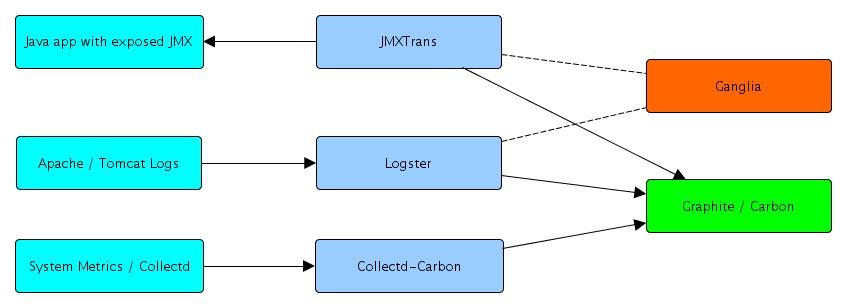
Given that @patrickdebois is working on improving data collection I thought it would be a good idea to describe the setup I currently have hacked together.
(Something which can be used as a starting point to improve stuff, and I have to write documentation anyhow)
I currently have 3 sources , and one target, which will eventually expand to at least another target and most probably more sources too.
If you are hacking on monitoring solutions, and want to talk to your peers solving the problem
Block the monday and tuesday after fosdem in your calendar !
That’s right on february 6 and 7 a bunch of people interrested to fix the problem will be meeting , discussing and hacking stuff together in Antwerp
In short a #monitoringsucks hackathon
Inuits is opening up their offices for everybody who wants to join the effort Please let us (@KrisBuytaert and @patrickdebois) know if you want to join us in Antwerp
I`m parsing the responses of the Deploying Drupal survey I started a couple of months ago (more on that later)
One of the questions in the survey is “What is devops” , apparently when you ask a zillion people (ok ok, just a large bunch of Tweeps..), you get a large amount of different answers ranging from totally wrong to spot on.
So let’s go over them and see what we can learn from them ..
This is a repost of my article earlier posted at Jordan Sissel’s awesome SysAdvent
After years of working in Java-based environments, there are a number of things that I like to implement together with the teams I`m working with - the application doesn’t matter much, whether it’s plain java, Tomcat, JBoss, etc, these deployment strategies will help your ops and dev teams build more managable services.
Packaging
The first step is to have the native operating system packages as build artifacts rolling out of your continuous integration server - No .ear, .war or .jar files: I want to have rpms or debs. With things like fpm or the maven rpm plugin this should not be an extra hassle, and the advantages you get from doing this are priceless.
Last week I was in Boston for my 1st and their 25th Edition of the Large Infrastructure System Administration Conferences
Lisa was pretty much all I expected from it. Old Unix wizards with long hair and white beards, the usual suspects, and a mix of devops practitioners on a devops themed conference with on one side awesome and well positioned content and on the other side absolutely basic stuff.
On tuesday I had a devops bof scheduled for 2 hours.